

How To Install Microstrategy Library
Installing and Configuring MicroStrategy Library
The MicroStrategy Library installation includes the MicroStrategy Balance Server likewise equally the MicroStrategy Collaboration Server, which enable the post-obit functionalities:
- Browse shared content: Users have admission to their own library where shared dossiers and documents are available to be consumed.
- Search for dossiers: Users can easily search for dossiers with matching criteria such as dossier name, chapter/page proper noun, etc.
- Manipulate the data view with visualizations and filters: Users tin consume the data in a dossier with visualization and filter manipulations. Every action is recorded in the metadata so that a user can resume from the final stopping point for the next login.
- Share dossier to other users: Users tin share their dossier view to other users. All of the manipulations will be carried over so that they consume the data based on same context.
- Interact with other users via comments and notifications (Collaboration Server): User can leave commentary, tag other users, and embed filters to collaborate with other users within any dossier.
The Collaboration Server also supports the post-obit avant-garde functionalities:
- Realtime monitoring of connected users: Every user that connects to the Library Spider web or Mobile application is tracked past this service.
- Realtime monitoring of user comments: Users can create comments associated with each individual page. Users will receive new comments equally they go far without the need for refreshing. Persistence of comments. Comments persist for retrieval at a later time.
- Comments can comprise "embedded objects": Users can store filter settings with a comment for another user to utilise.
- User mention and notification: Users tin ship notification to another user via user mention. In add-on to "in-app" notification, users tin can too be notified by APNS (device notification) and email notification.
MicroStrategy Library Architecture
The following terminology volition help you to understand what is behind the Collaboration Server.
- Web Socket is a protocol providing full-duplex advice channels over a unmarried TCP connection. Spider web Socket is supported with all major browsers and can be used in mobile applications. For Spider web Socket to work in an application, an application server (web server) needs to support it as well.
If the Library cannot found a Web Socket connection due to a blocked protocol in an surroundings that contains load balancers, information technology attempts an HTTP connection and uses a technique called "long polling" to simulate a real time message commutation.
- Node.js is an open-source, cross-platform runtime environs for developing server-side Spider web applications. Node.js is the runtime environment for hosting the MicroStrategy Collaboration Server.
- PostgreSQL is an open-source relational database management system used to store collaboration data for the MicroStrategy Library application.
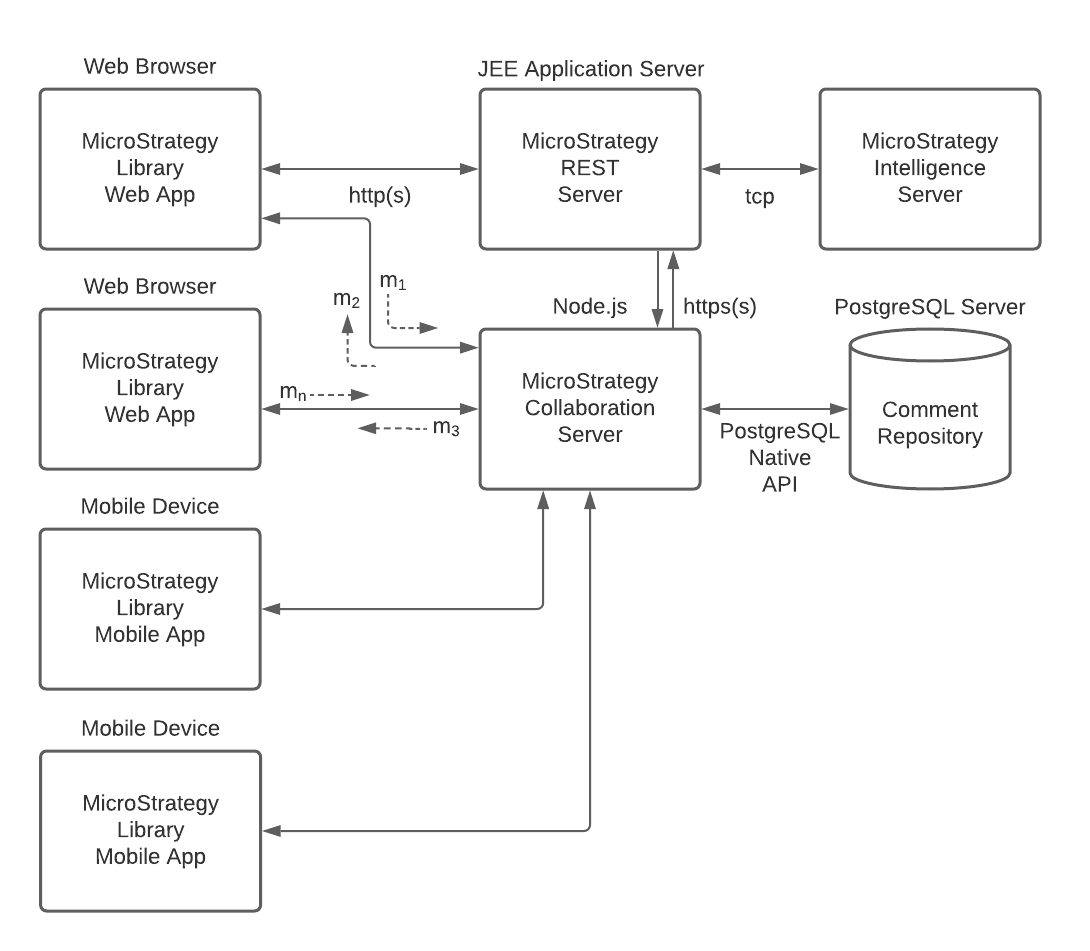
The following diagram shows the Library architecture, including the Collaboration Server.
Messages flow in both directions of a Web Socket connection. The MicroStrategy Collaboration Server manages which messages become to which clients based on a publish-subscribe model. A customer awarding may publish a annotate to a topic, and all clients subscribed to the topic will be notified.

Source: https://www2.microstrategy.com/producthelp/Current/InstallConfig/en-us/Content/install_config_library.htm
Posted by: gideongallembey.blogspot.com
0 Response to "How To Install Microstrategy Library"
Post a Comment